 By Walker
In a notable shift in Uganda’s debt landscape, pension and provident funds have emerged as the largest holders of the country’s public domestic debt, surpassing commercial banks for the first time.
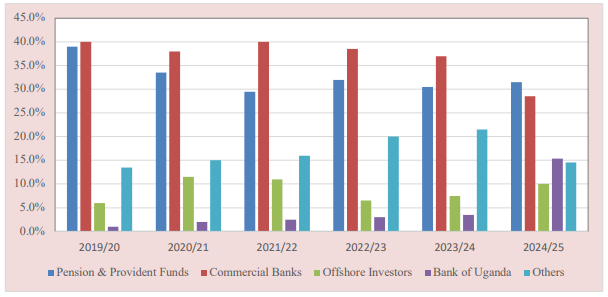
According to the latest Debt Sustainability Analysis report for the 2024/25 fiscal year, these institutional investors now hold 31.5 % of all government debt owed domestically — up from 30.5 % in 2023/24. By comparison, commercial banks’ share fell to 28.6 %, marking a major change in the makeup of Uganda’s internal creditors.
Rising Role of Institutional Investors
The increasing share of pension funds highlights a maturing domestic financial market and growing confidence among institutional savers in government securities. Long-term investment horizons typical of pension funds make them well-suited for holding government paper such as Treasury bonds.
Over recent years, banks had dominated the government’s domestic debt portfolio, holding as much as 40 % of public debt in the 2019/20 financial year. However, their proportion has gradually declined, while pension funds steadily increased their participation.
Domestic Versus External Borrowing
The shift in debt ownership coincides with a broader trend toward increased reliance on local lenders. Data from the Ministry of Finance shows that by June 2025, 52.1 % of Uganda’s public debt was held domestically — a noticeable rise from 42.8 % previously. Conversely, the share of external debt dipped to 47.9 %.
Changing Composition and Emerging Players
Aside from pension funds and banks, other categories of investors have also altered their stakes. Notably, the Bank of Uganda’s holdings rose sharply to 15.4 % of domestic debt, largely driven by the securitisation of central bank advances — a policy move rather than purely market-based change. Offshore investors also increased their presence, holding around 10 % of domestic debt.
Impact on the Financial Sector
Experts say this evolving debt profile has implications beyond the numbers. Heavy reliance on domestic borrowing — especially from banks — has long drawn criticism for crowding out private sector credit. With pension funds now taking a larger slice, there is potential for reduced pressure on banks, which could, in turn, improve lending conditions for businesses.
The shift toward long-term institutional capital as a primary backer of government debt may reflect confidence in Uganda’s economic outlook and financial market depth. However, policymakers will need to continue balancing domestic and external sources to maintain sustainable fiscal management.